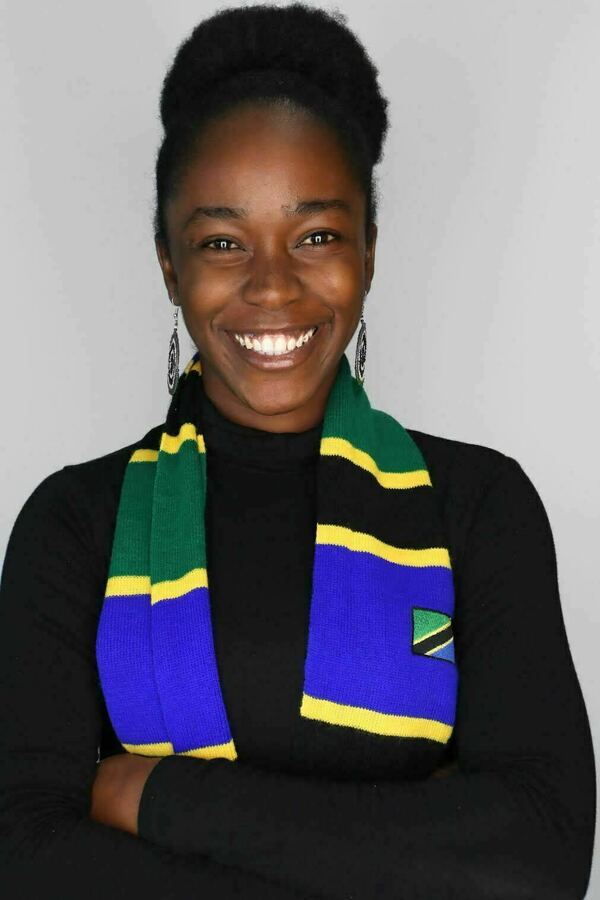
Miriam Mwakalibule, a vibrant and dedicated teacher from Dar es Salaam, Tanzania, has found her way to the University of Notre Dame as a Swahili Fulbright Foreign Language Teaching Assistant (FLTA). Miriam’s journey from Tanzania, a country with 120 distinct tribes and rich diversity, to the historic grounds of one of America’s most prestigious universities offers a glimpse into her passion for language, cultural exchange, and her commitment to uplifting her community.
As a member of the Nyakyusa tribe, Miriam is no stranger to a warm and welcoming community. Known for its beautiful beaches and the genuine hospitality of its people, Dar es Salaam has been the foundation of her values and drive. Miriam pursued a B.A. in Linguistics and Literature from the Dar es Salaam University College of Education (DUCE), where she became captivated by the world of languages and cultural expression.
For many in Tanzania, English is perceived as a difficult language to master. As a high school student, however, Miriam was inspired by a dedicated teacher who encouraged her to embrace English—a mandatory subject—and view it as a pathway to new opportunities. Miriam became intrigued by the fact that English is spoken across so many countries. Her determination to master it and pass on her knowledge led her to participate in the Access Program, which was sponsored by the U.S. Embassy, as well as the Pan-African Youth Leadership program.
Through the Access Program, Miriam not only enhanced her English skills but also developed a passion for teaching others. Motivated by the impact of language learning in her own life, she started an English club at a local primary school. For five months, she worked with young students near her high school, helping them strengthen their English skills and inspiring them to see English not as a difficult subject but as a key to greater opportunities.
It was while exploring the U.S. Embassy’s website that Miriam discovered the Fulbright program. Watching videos of former FLTA participants sharing their experiences, she saw an opportunity to further her teaching journey and to share Swahili and Tanzanian culture with students abroad. When it came time to choose a university, Miriam was drawn to the University of Notre Dame for its reputation as one of the top universities in the United States. It offered an environment she felt was not only academically rigorous but also unique and enriching.
At Notre Dame, Miriam teaches Beginning Swahili I and Intermediate Swahili II, enjoying every moment of working with her students. She describes them as collaborative, hardworking, and friendly, which has made the experience “excellent” for her. Notre Dame, with its beautiful campus and welcoming community, feels to her like “home away from home,” a place where she feels she has already been for a long time, despite it being just a few short months since she arrived in the United States.
Miriam’s experience at Notre Dame has not only enriched her teaching skills but has also inspired her to consider further education. She now plans to attend graduate school, a goal reinforced by her time at Notre Dame, where the supportive environment has motivated her to dream bigger. Her advice to anyone learning Swahili is to embrace it fully, as it is a language that connects diverse cultures across the African continent.
Miriam Mwakalibule’s story is just one of the many examples of the doors that open through language and cultural exchange. Through her work as an FLTA, she has not only brought a piece of Tanzania to Notre Dame but has also inspired her students to see the world in a new light—one Swahili word at a time.
About the CSLC
The Center for the Study of Languages and Cultures (CSLC) aims to support language learners at ND by facilitating meaningful experiences with linguistic acquisition and exchange - both in our campus community and abroad. We believe that access to the world's languages and cultures allows us to seek out new perspectives, to value the diversity of the world's cultures, and to embody global citizenship.