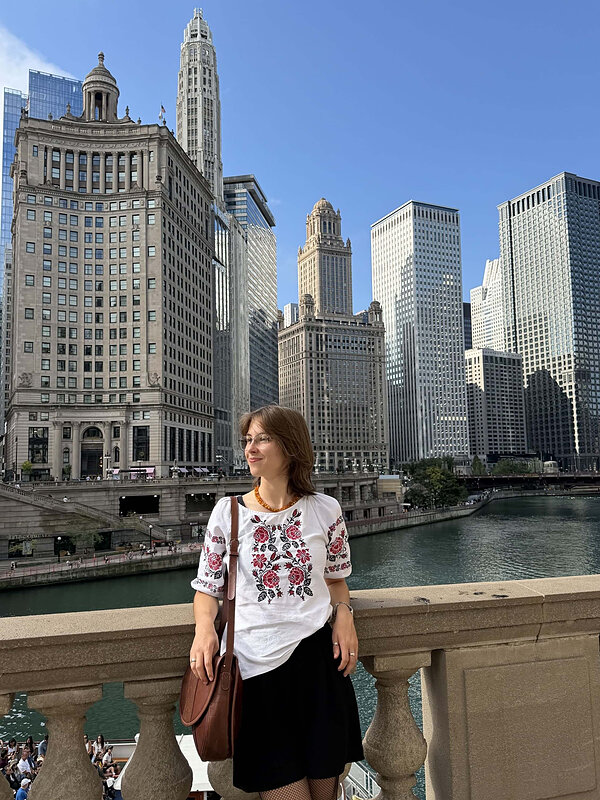
Ella came to Notre Dame from Ukraine through the Fulbright Foreign Language Teaching Assistant Program. During her time here, she is sharing her language and culture with students while gaining experience as an educator.
Ella is from Chornobai, a small town of approximately 6,000 people in central Ukraine near the Dnipro River, the country’s largest river. She spent the past five years in Lviv, one of Ukraine’s largest cities, where she completed a four-year degree in linguistics at the Ukrainian Catholic University. While studying, she taught English to teenagers and adults, gaining five years of teaching experience. After graduating, she took a gap year to focus more fully on her professional development.
During that year, Ella worked as a communications manager for a nongovernmental organization that combats illegal logging in the Carpathian Mountains. The role gave her the opportunity to apply the language and communication skills she had developed through both her education and teaching experience while contributing to an important environmental cause.
Ella first learned about the Fulbright Foreign Language Teaching Assistant Program while completing her undergraduate degree at Ukrainian Catholic University in Lviv. The university’s School of Ukrainian Language and Culture offers courses for international students who want to learn Ukrainian. During her undergraduate studies, Ella took a course on methods for teaching Ukrainian as a foreign language, which introduced her to a new area of language education.
During the course, an alumna of the 2023 FLTA program at the University of Texas spoke to Ella’s class about her experience. Ella was only in her third year at the time, but the conversation stayed with her. The following summer, she worked as a tutor for the university’s Ukrainian language and culture program. She helped students with their homework, pronunciation, and grammar. Her students came from the United States, Australia, Europe, Asia, and many other parts of the world. Ella enjoyed teaching them, but she was equally interested in learning about their countries and cultures. The experience showed her that the FLTA program would allow her to grow as an educator while continuing this kind of cultural exchange.
When Ella was selected for the Fulbright program, Notre Dame felt like a natural choice. Ukrainian Catholic University has a long history of connections with Notre Dame. One of Ella’s former classmates studied at Notre Dame for a semester and later returned to pursue a master’s degree in English literature through a Fulbright scholarship. Knowing that an established Ukrainian community existed on campus reassured Ella that she would not be alone.
Notre Dame also offered her the opportunity to learn more about Catholic culture and the role of the Catholic Church in the United States. Although Ella is Protestant, she lived in Lviv, a city deeply influenced by the Ukrainian Greek Catholic Church. Growing up around that tradition made her interested in religious cultures beyond her own. She is also interested in the history of the Ukrainian Greek Catholic diaspora in the United States. Many Ukrainian Catholics came to the country after fleeing occupation and persecution in Galicia, a historical region that includes Lviv and parts of western Ukraine. Their communities have played an important role in maintaining Ukrainian religious and cultural traditions abroad.
This Fulbright year is Ella’s first time in the United States. One of the first differences she noticed was the country’s transportation infrastructure. Like many Europeans, she was surprised by how heavily American life depends on cars. However, the scale of American college life made an even greater impression on her.
She admires Notre Dame’s campus and the wide range of services available to students. The university functions almost like its own community, with academic, residential, athletic, religious, and social life concentrated in one place. After experiencing Notre Dame, Ella began to recognize how much her own university had been inspired by the American university model.
Ella currently teaches a one-credit Ukrainian language course and contributes to two other courses, Tour of the Post-Soviet States and Society and Culture: Ukraine. Even from her first language lesson, she noticed several challenges that English-speaking students may face. The Cyrillic alphabet can be confusing because some letters resemble English letters but represent entirely different sounds. Other letters are completely unfamiliar to English speakers. She also expects declensions to be challenging. In Ukrainian, the endings of nouns, pronouns, and adjectives change depending on their role in a sentence. Students must also learn the grammatical genders assigned to Ukrainian nouns.
Although these features may initially seem intimidating, Ella emphasizes that learning the language is absolutely possible. Her advice is to avoid becoming too stressed about grammar, especially as a beginner. Instead, students should search for content in the language that genuinely captures their interest. “Find a silly children’s series, a cartoon, or a book that you enjoy,” she said. “Try to feel the language and see how it exists in real life.”
After Fulbright, Ella is considering two very different paths. One possibility is joining Teach For Ukraine, an initiative modeled after Teach For America. Her boyfriend currently participates in the program, and Ella could join him in teaching English or Ukrainian language and literature. Her second possibility is joining the military. She is not yet certain what role she would pursue, but she believes her language skills could allow her to serve as an interpreter working with international soldiers and partners. Both possibilities reflect the same commitment that brought her to Notre Dame: using language in service of other people and her country.
Ella’s favorite Ukrainian word captures that commitment. The word is “воля,” pronounced approximately “volya.” It can mean freedom, liberty, or free will. Its meanings connect personal choice with a nation’s right to determine its own future. For Ella, “воля” represents both the spirit of Ukraine and the purpose behind her journey to the United States. Through teaching, cultural exchange, and conversation, she hopes to help others see Ukraine not only as a country at war, but as a country with its own language, history, faith, and culture.
About the CSLC
The Center for the Study of Languages and Cultures (CSLC) aims to support language learners at ND by facilitating meaningful experiences with linguistic acquisition and exchange both in our campus community and abroad. We believe that access to the world's languages and cultures allows us to seek out new perspectives, to value the diversity of the world's cultures, and to embody global citizenship.